If you run HR for a company of 30 to 300 people, the biggest software story of the month is not your deal. It is still your market.
On 13 August, Reuters reported that private equity firm Silver Lake is negotiating to acquire Workday, in what the wire copy called a transaction that “would rank among the largest software buyouts in history.” Six days later, that is still the whole story. No signed agreement, no confirmation, no denial.
Which makes this a good week to do something more useful than speculate: read your own contract.
What was actually reported, and what was not
Here is the sourced part, and only the sourced part.
Reuters broke the story on 13 August. Workday’s market value was around $43 billion before the report. On the day, shares closed nearly 18% higher at $206.45, putting the company at roughly $51.1 billion. The same reporting notes that Workday serves over 11,500 customers globally, including Netflix, U.S. Bank and Johns Hopkins University.
The talks themselves are not a deal. As RTÉ reported carrying the same Reuters copy: “The talks are ongoing and there is no guarantee a deal will materialize.” Neither Silver Lake nor Workday immediately responded to requests for comment. As of publication, I have not found any public confirmation or denial from either side.
Context on why a take-private is even on the table: before the report, Workday shares were down roughly 15% year to date and more than 40% off their 2024 peak, as investors questioned the durability of traditional software in an era of rapidly advancing AI.
Everything past this line is analysis. Nobody outside the room knows whether this closes, at what price, or with what plan attached.
What ownership changes have meant for customers before
Two precedents are worth putting side by side, because they are commonly mashed together and they are not the same thing.
Citrix is the private equity case. Citrix was taken private in a $16.5 billion deal by affiliates of Vista Equity Partners and Evergreen Coast Capital, completed in 2022, and merged with TIBCO into Cloud Software Group. In March 2024, The Register reported that Citrix would “charge double the price for its wares unless partners pay upfront for a year.” That is a reported PE-ownership example of channel pricing and payment terms tightening after the deal.
VMware is the louder case, and it is not private equity. Broadcom is a publicly traded strategic acquirer, not a buyout firm, so it belongs in a different bucket. Under Broadcom ownership, CISPE members told the European Commission they faced price increases ranging from 800% to 1,500%, with many seeing licensing costs rise tenfold. Anyone citing that number as proof of what PE does to customers is citing the wrong deal.
The analyst read on Workday specifically is not uniformly grim. Speaking to Reworked, Constellation Research’s Holger Mueller called the prospect “good news for customers,” while recommending customers reconfirm roadmap commitments. In the same piece, Jason Averbook of Now to Next told customers to monitor the economics: pricing, support, contract terms and change-of-control language.
My own read, clearly labeled as opinion: two precedents are not a pattern, and neither predicts Workday’s outcome. What they do establish is narrower and more useful. When ownership changes, the roadmap you were shown in a QBR does not transfer. The contract you signed does.
What mid-market HR buyers should ask now
This is the practical part, and most of it is standard renewal hygiene rather than anything Workday-specific. Averbook’s four watch items above are the sourced version. The rest is how I would run it.
Find your renewal date and your notice window. Not the contract end date, the date by which you have to give notice. Many enterprise agreements auto-renew if you miss it by a day. If you cannot answer this from memory, that is the whole problem.
Check whether you have a price cap in writing. An uplift ceiling on renewal, expressed as a percentage, is the single clause that decides whether a new owner’s pricing strategy is your problem or theirs. If you do not have one, the time to ask for one is at your next renewal, not after an announcement.
Read your change-of-control language. What happens to your terms if the entity you signed with is acquired? Does anything trigger, or does the agreement simply carry over intact?
Separate contractual roadmap commitments from slideware. Ask which of the modules you were promised are actually named in an order form with a date, and which are ambitions. That distinction rarely matters until it suddenly does.
Price your exit before you need it. What format does your data come out in, how long does extraction take, and does it cost anything? A vendor’s answer to that question tells you a lot about how they expect the relationship to end.
Confirm what support you are contractually owed. A named customer success manager as a courtesy and a named CSM in the agreement are different products, and the first one is the one that gets consolidated first in a cost-out program.
None of this requires you to switch anything. Switching HR systems because of a Reuters headline about talks would be an expensive overreaction. Knowing your notice date costs an afternoon.
Where Growee fits (our own product, so read it as such)
This section is about the thing we sell, and I would rather label that than bury it.
Growee is built for the segment large HCM suites are not designed around; that is scope, not a jab. Workday’s flagship third-party recognition is Leader in the Gartner Magic Quadrant for Cloud HCM Suites for 1,000+ Employee Enterprises, for the tenth consecutive year. Read the scope literally.
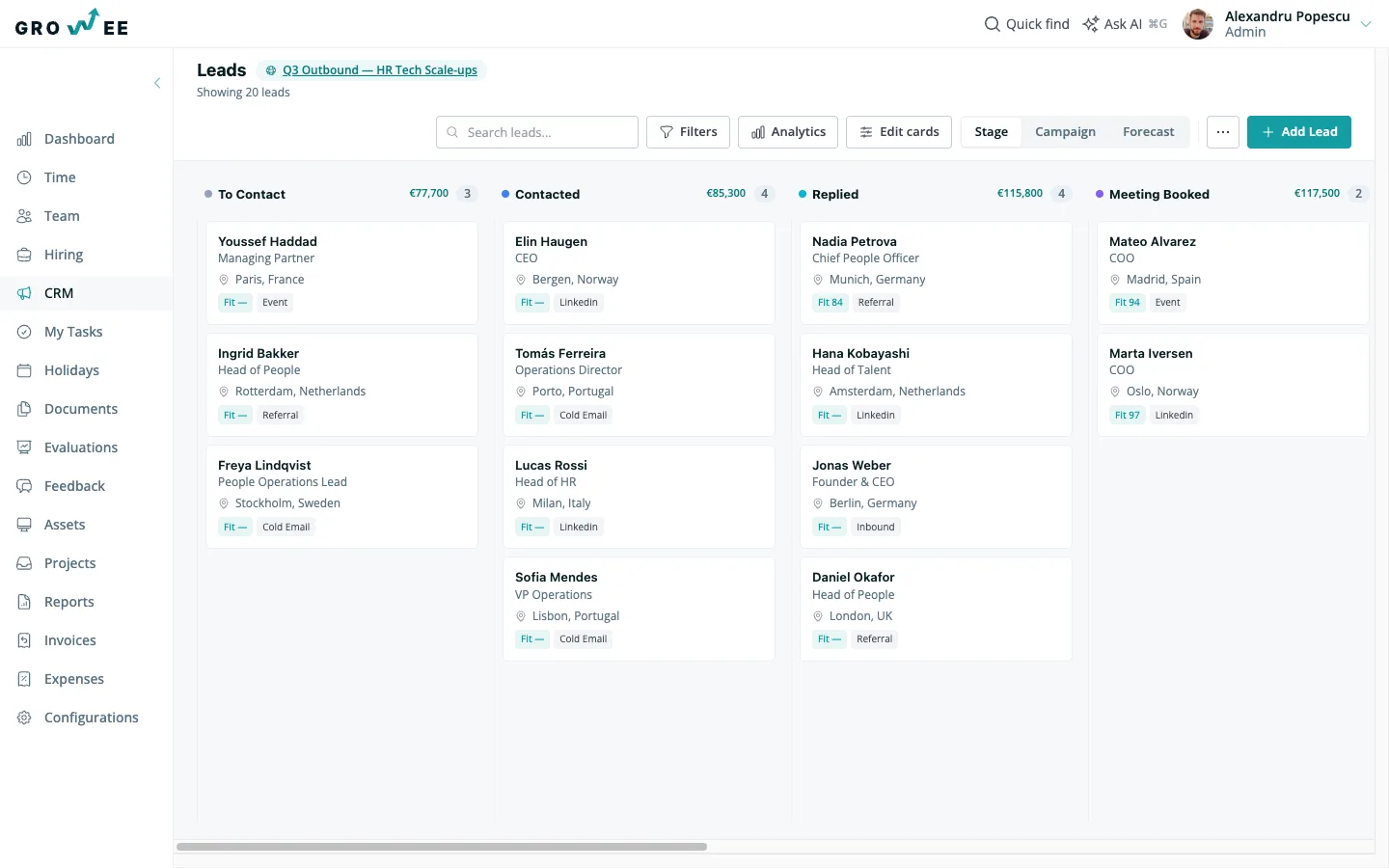
On pricing, our numbers are published rather than quoted. In EUR: the Free plan covers up to 3 employees, Pro is €2 per active employee per month or €20 per active employee per year, and the add-ons are CRM at €49 per month (with a free tier of 100 leads), Knowledge Base at €29 per month (free tier of 10 documents), and Hiring at €10 per job post plus €1 per candidate. Those figures are on our pricing page and in this post because you should be able to check them without a call.
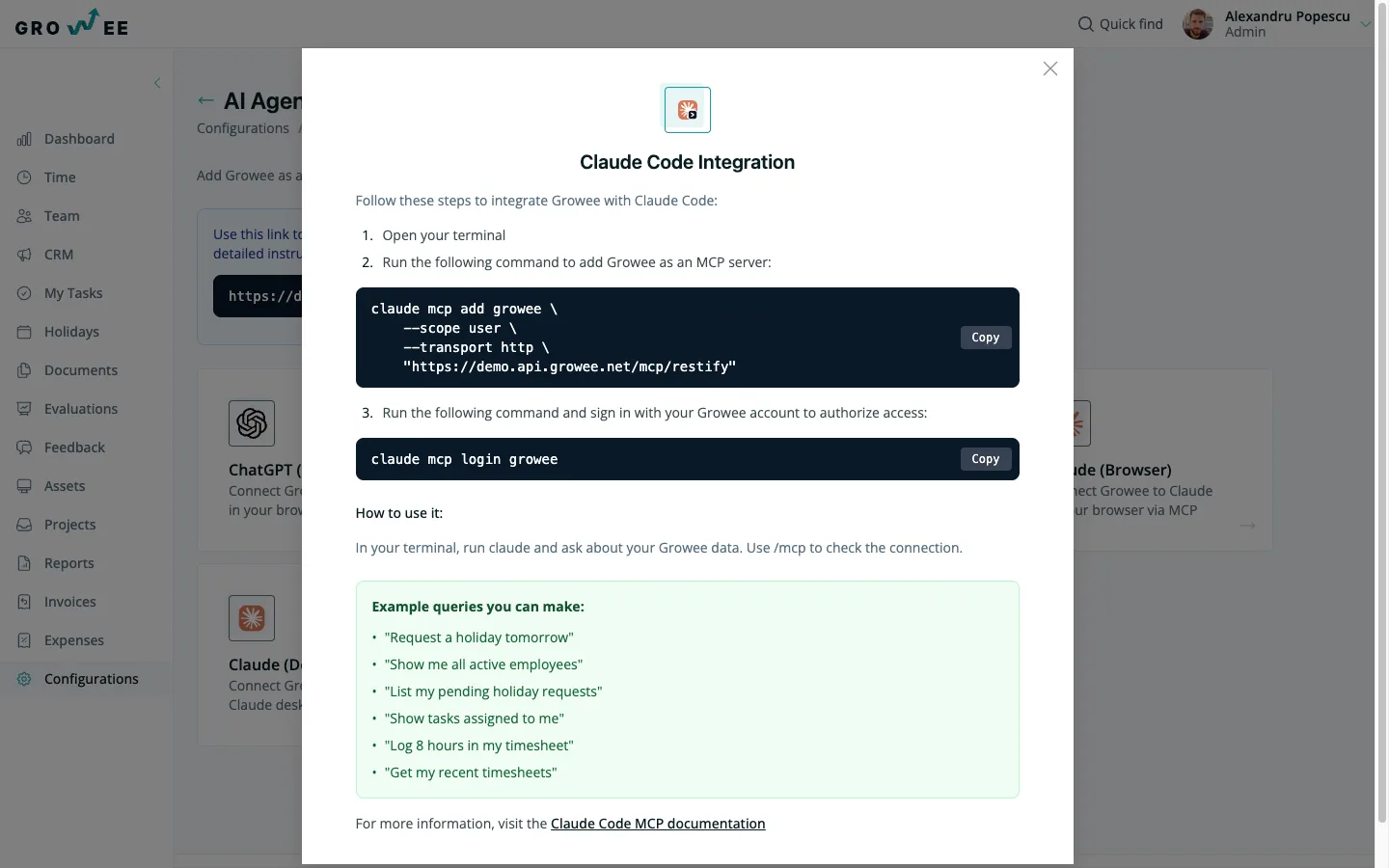
On AI, we build it into the workflow rather than beside it: CV parsing and job description generation in hiring, AI drafted campaign messages in the CRM, and an MCP server per tenant so Claude or ChatGPT can read and write your Growee data, bounded by your Growee role when you sign in with OAuth. The defaults are human in the loop by design. AI drafted campaign messages sit as an editable draft, and campaign auto-send is off unless you turn it on.
The honest caveat: small vendors get acquired too, and published prices can change. What protects you is not the vendor’s size but terms you can read before you sign.
The short version
Silver Lake and Workday are in talks; that is the only deal fact anyone has. Everything else, including this post’s read on what a new owner would do, is inference.
If the story moves you to do exactly one thing, make it this: open your current HR contract, find the notice date, and check whether there is a cap on the renewal number. That work pays off whichever way the deal goes, and whoever your vendor is.