Short answer: in a 20-person company it does not live in one place. Some is CRM data. The rest is people records, the leave calendar, logged hours, project budgets and invoices. HubSpot spent September arguing that context, not model quality, decides whether agents deliver. That is right, and it makes the questions worth putting to any vendor: which records an agent reaches, under whose permissions, and what it logs.
What HubSpot published, and when
Read from hubspot.com and ir.hubspot.com on 23 September 2026.
HubSpot held its analyst day alongside UNBOUND 26 on 17 September 2026, and the corrected transcript it publishes on its investor site is blunt about what shipped. Kathryn Bueker, its Chief Financial Officer, told the room: “In addition to customer, prospecting and data agent, we launched campaign, nurture, content and revenue agents this week at UNBOUND.” She put reach beside it: “19% of Pro+ customers using HubSpot used HubSpot agents as of August, and this is up two times from the beginning of the year”, with “monthly agentic actions increase by 3.5 times” and “monthly credit consumption more than double, even with the change that we made in April to lower agent prices and shift to outcome-based pricing”.
The argument underneath ran through three newsroom posts. On 9 September 2026, under the title “The Real AI Race Isn’t About Models or Data. It’s About Context.”, HubSpot states its thesis in a line: “Context is not a feature; it is necessary infrastructure.” On 16 September, the Fall 2026 Spotlight post describes a Breeze Assistant that routes work to agents rather than doing it alone: “Tell it what you need, it assigns the right agents to get it done”.
On 21 September 2026, “The Outcomes Era is here” supplies the definition: “context is the dynamic knowledge about your business, your customers, and your team.” It names three ingredients, and the third repays a second read: “you need team context: who you are. This includes your workflows and handoffs, roles and permissions, approval rules, and escalation triggers.” The same post reports that when the same AI models were paired with bad context, outcomes “were worse than using no AI at all”.
Agent sprawl is the named problem: Agent Hub and Agent Builder arrived in public beta on 23 July 2026 against agents that “are scattered and disconnected”.
The adoption figures above are quoted from the corrected transcript HubSpot publishes from its investor day, not from a third-party summary.
Everything past this line is my read, not HubSpot’s.
Why this lands differently at 20 people
Look again at HubSpot’s own list: workflows and handoffs, roles and permissions, approval rules. Most of that is not CRM data, and at 200 people it lives in systems a revenue platform can reasonably ignore. At 20 people it is the business.
Take a normal Monday question: can we take this project? Answering it needs the pipeline, and also who is free, who is on leave in October, what the team costs against what the client pays, and whether the last invoices were paid. One of those five is a CRM record.
Three questions to ask any vendor
1. Which records does the agent reach? Ask for the list, not the category. “It connects to your HR data” can mean a name and a start date, or salary history and contracts. That decides how much of your Monday question gets answered, and how much is exposed if the connection is abused.
2. Whose permissions bound it? One design runs each call as the person asking, inheriting the permissions they already hold. Another provisions a service account with broad scope, which quietly means anyone who reaches the assistant reaches whatever that account reaches. Ask which one it is, in those words.
3. What does it log? A line reading “Maria updated this record” is technically true and practically useless when Maria asked an assistant to do it. Ask whether an agent-made change stays distinguishable from a human one, in the product rather than the roadmap.
Where Growee fits, and this is our own product
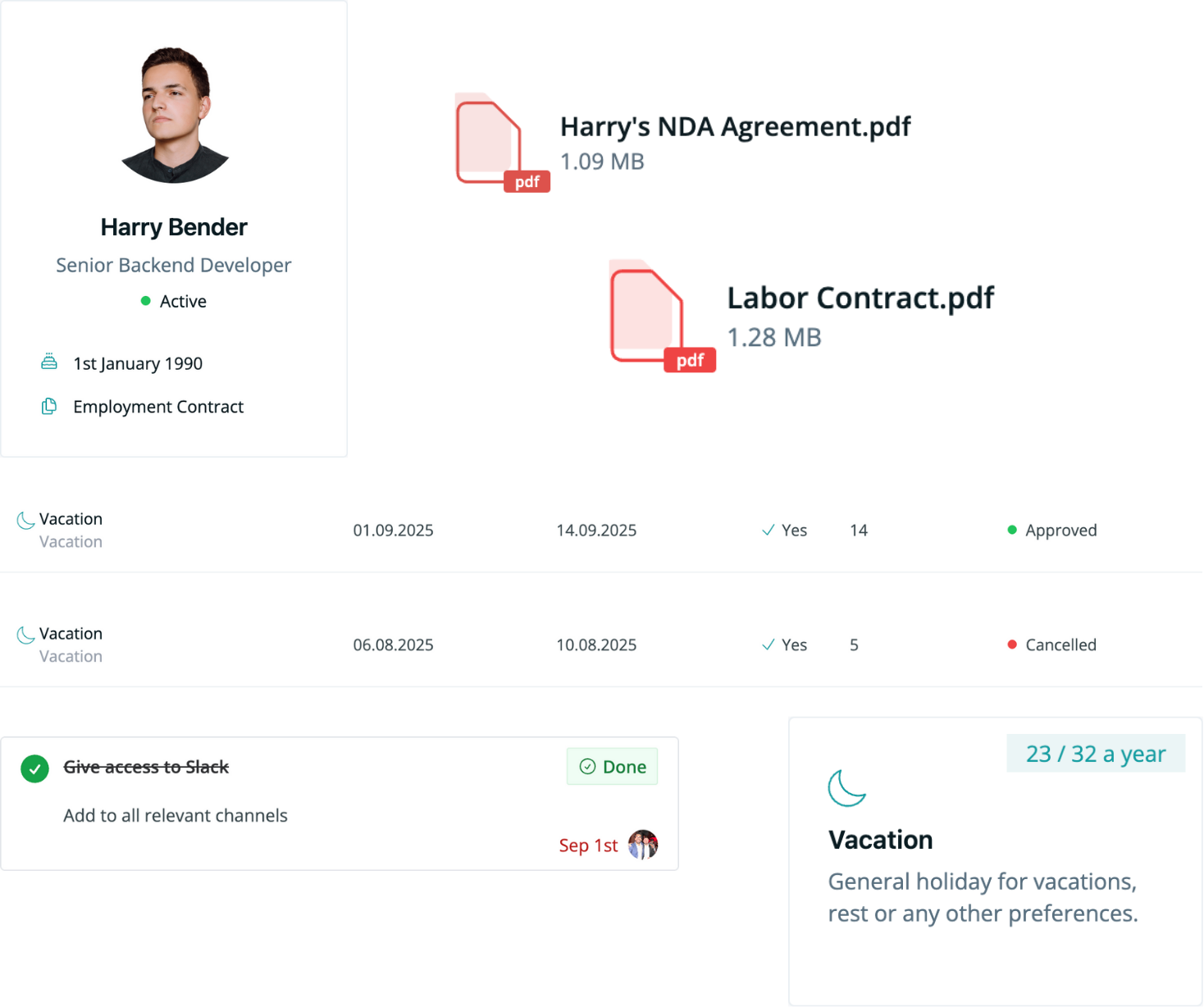
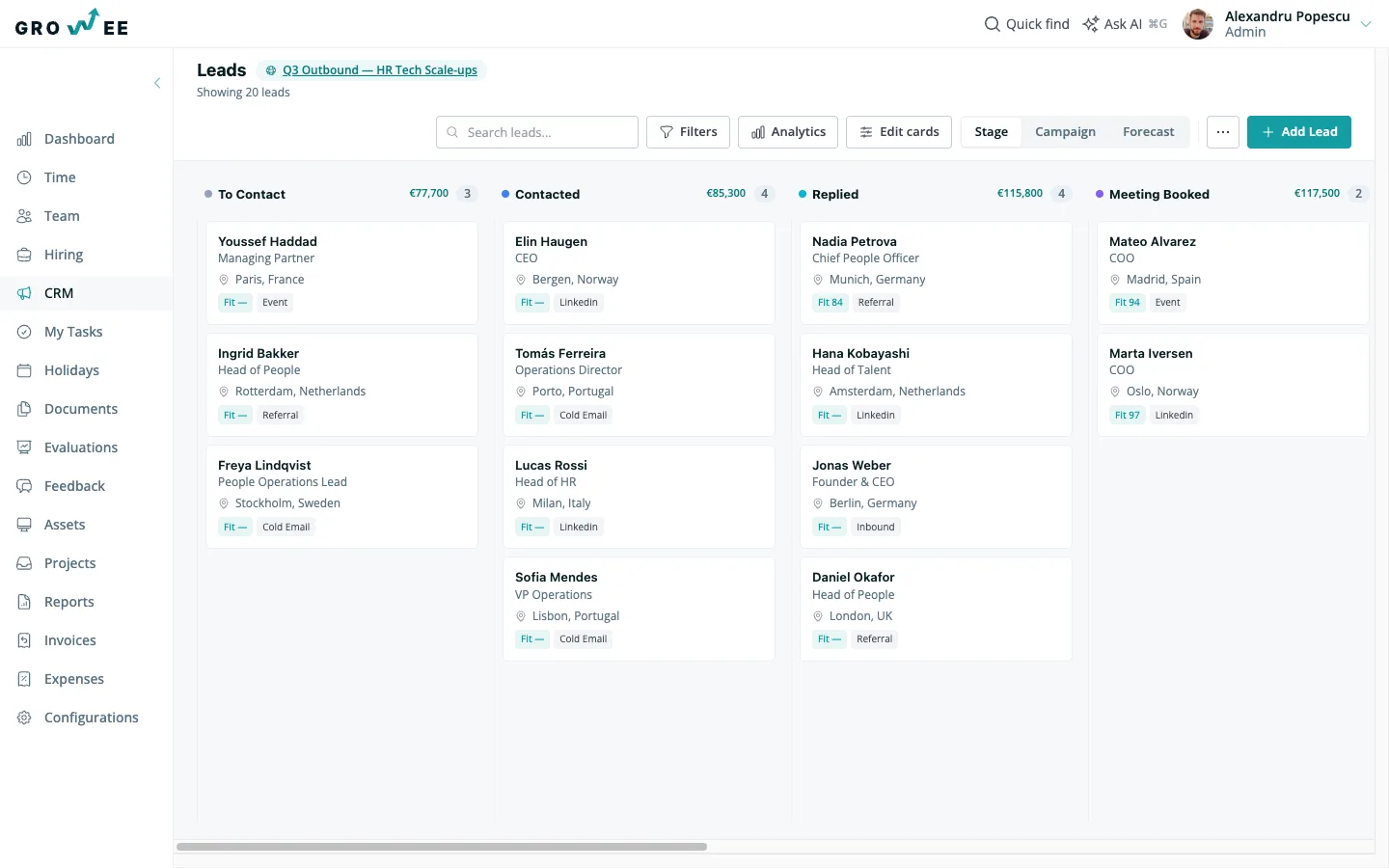
Growee is one workspace holding people, leave, logged hours, projects, clients, invoices and a CRM on the same schema. That answers question one: the records an assistant reaches are the ones a small company runs on, not the CRM slice.
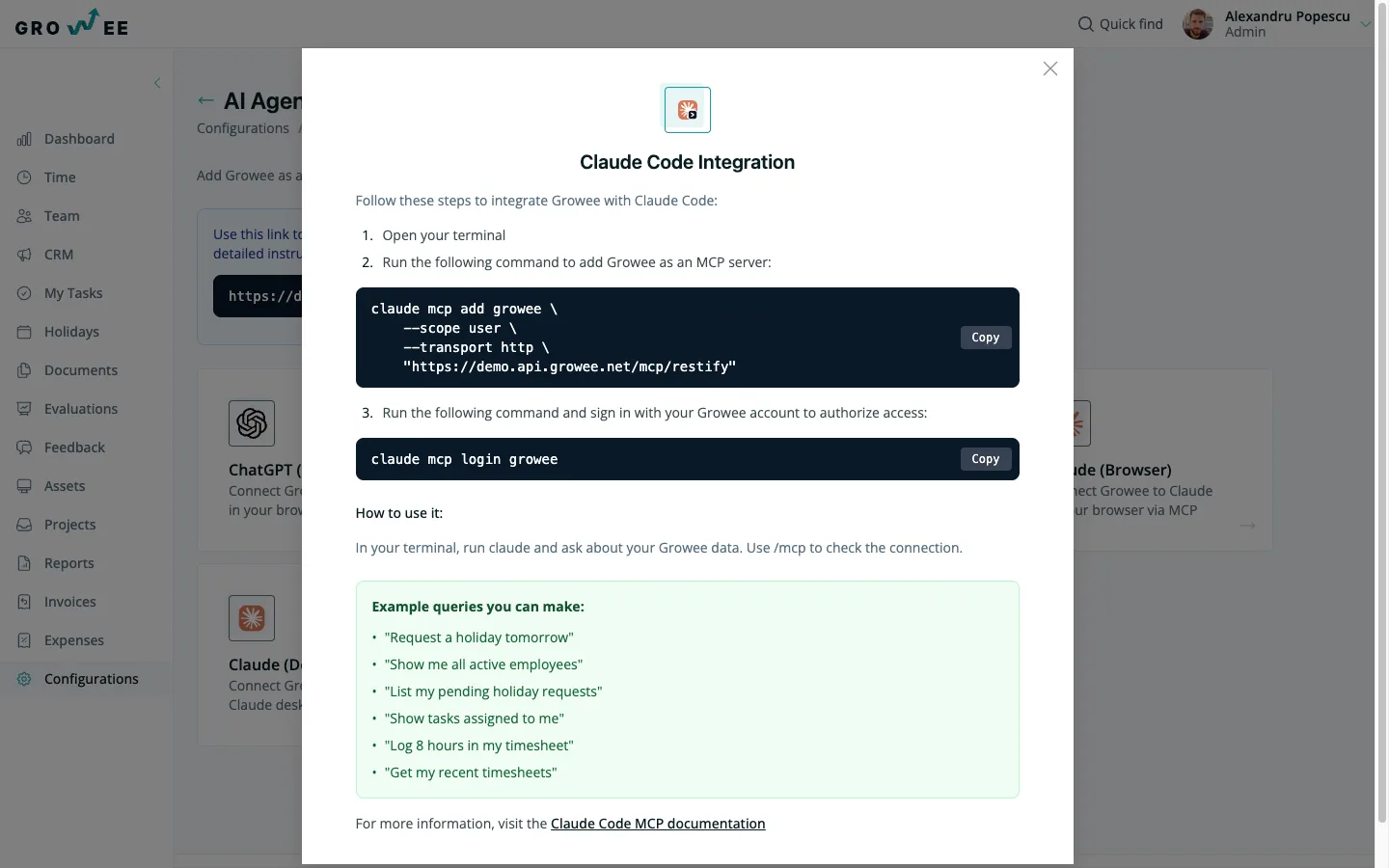
On question two, every call through our MCP server runs as your own signed-in Growee user inside your tenant. Reads and writes run under the same policies and tenant scope the app applies, and how tight that is varies by record type. Connection is by OAuth 2.1 with PKCE and dynamic client registration, or by a personal access token, on one scope, mcp:use. Your permissions decide what the assistant reaches; the plan decides the meter. On the free plan, calls are metered at 1,000 successful MCP tool calls a month, and on any paid plan the meter comes off.
On question three I would rather state the gap. Growee keeps per-record history in places like invoices, but it does not ship a workspace-wide audit trail separating an agent-made change from a human one. I am publishing the question anyway: a checklist you print when you win it is not a checklist.
Two limits worth naming. Growee does not run payroll, so the pay context an agent might want is not ours to hold, and CRM import brings in leads, not an entire CRM history. The HubSpot comparison covers the rest of that trade.
The short version
HubSpot’s September argument is the correct one: agents are as good as the context they act on, and that context includes roles, permissions and how work moves, not records alone. Taken seriously, it points somewhere those posts do not go. At 20 people the context is spread across your people, your hours, your projects and your invoices, and which system holds it is a decision you make once.
Ask the three questions. Get the answers in the order form, not the demo.