On the record so far, both can be on the hook: the vendor that builds the screening logic and the employer that switches it on. On 12 July 2024 the Northern District of California held that Workday can be sued directly under Title VII, the ADEA and the ADA as an “agent” of the employers who handed it their screening, because “[e]mployers cannot escape liability for discrimination by delegating their traditional functions, like hiring, to a third party.”
The case is Mobley v. Workday, No. 3:23-cv-00770-RFL, before Judge Rita F. Lin. Workday is the only defendant; no employer-customer has ever been joined. As of 25 August 2026 it is in discovery, with nothing decided on the merits and no trial date in the public record; the 2 July 2026 order noted Workday’s motion to decertify the ADEA collective was due within the month.
This is not legal advice. It is a plain-language summary written by a software team, and every legal claim below links to the filing it comes from. Review your own setup with your counsel before you rely on any of it.
Six dates that carry the case
| Date | What happened | Source |
|---|---|---|
| 19 January 2024 | Workday’s first motion to dismiss granted, with leave to amend | Order summary |
| 9 April 2024 | The EEOC files a district-court amicus brief arguing three theories of vendor liability | EEOC brief, Dkt. 60-1 |
| 12 July 2024 | Disparate-impact claims proceed on an “agent of employers” theory; the employment-agency and intentional-discrimination claims are dismissed | Order, Dkt. 80 |
| 16 May 2025 | A nationwide ADEA collective is preliminarily certified: applicants aged 40 and over denied employment recommendations since 24 September 2020 | Order, Dkt. 128 |
| 22 June 2026 | Most of Workday’s motion against the Third Amended Complaint is denied; the California FEHA claims largely survive; the direct-employer theory is dismissed | Order, Dkt. 360 |
| 2 July 2026 | Workday’s request to appeal the ADEA disparate-impact ruling before trial is denied; the case stays in the district court | Order, Dkt. 376 |
What the rulings actually say
Three theories of vendor liability have been ruled on so far. One survived.
Agent of employers, survives. The operative theory, established in the 12 July 2024 order and carried through every ruling since. The court wrote that accepting Workday’s argument “would allow companies to escape liability for hiring decisions by saying that function has been handed over to someone else (or here, artificial intelligence).”
Employment agency, rejected. The same order held Mobley “has not sufficiently alleged that Workday finds employees for employers,” which is the function that definition turns on.
Direct employer, rejected. On 22 June 2026 the court dismissed the “direct employer claim(s) about Workday’s own hiring and recruitment” and denied most of the rest of the motion.
One sentence matters most if you buy this kind of software, and it comes from the July 2024 order, describing what the complaint alleges: “According to the FAC, Workday’s software is not simply implementing in a rote way the criteria that employers set forth, but is instead participating in the decision-making process by recommending some candidates to move forward and rejecting others.”
Our read: the hinge is participation in the decision, not the word “AI” on the pricing page. A tool that applies a filter a recruiter typed sits in a different place from a tool that scores, ranks and recommends. That used to be a design choice. It is now also a legal one.
One more thing to carry into a vendor conversation: the intentional discrimination claims were dismissed without leave to amend in the same July 2024 order, so what survives is disparate impact, which turns on outcomes rather than anyone’s intent.
What the case does not decide
Workday has not been found to have discriminated against anyone; these are pleading-stage rulings about which claims may proceed. And because no employer-customer has ever been a defendant, the case does not adjudicate employer liability at all.
Our read: that absence is a reason for buyers to pay attention rather than relax. The agent theory adds the vendor to the claim. It does not subtract the employer who chose the tool and acted on what it returned.
What to ask a hiring-software vendor
Screening AI is sold as a speed feature, and speed is what a demo shows. After Mobley the buying question is a liability one: who decided, what got recorded, and can you show a person in the loop. Four questions get you most of the way there.
- Does the product ever change a candidate’s stage, rank or visibility without a person clicking something? What triggers it?
- When a candidate is rejected, what is stored: who decided, when, and on what basis? Can we export that for one job and one date range?
- What do your scores measure, who can override them, and is the override recorded?
- Which of these duties are yours and which are ours? Get the answer in writing.
Where Growee sits, honestly
Growee has a hiring module and there is AI in it, so here is the specific version.
Growee ships nothing that screens candidates out. No code path we ship moves a candidate into a rejected stage, archives them or sends a rejection based on a score, time in stage or anything else. Scoring is something you run, not something that happens to a candidate.
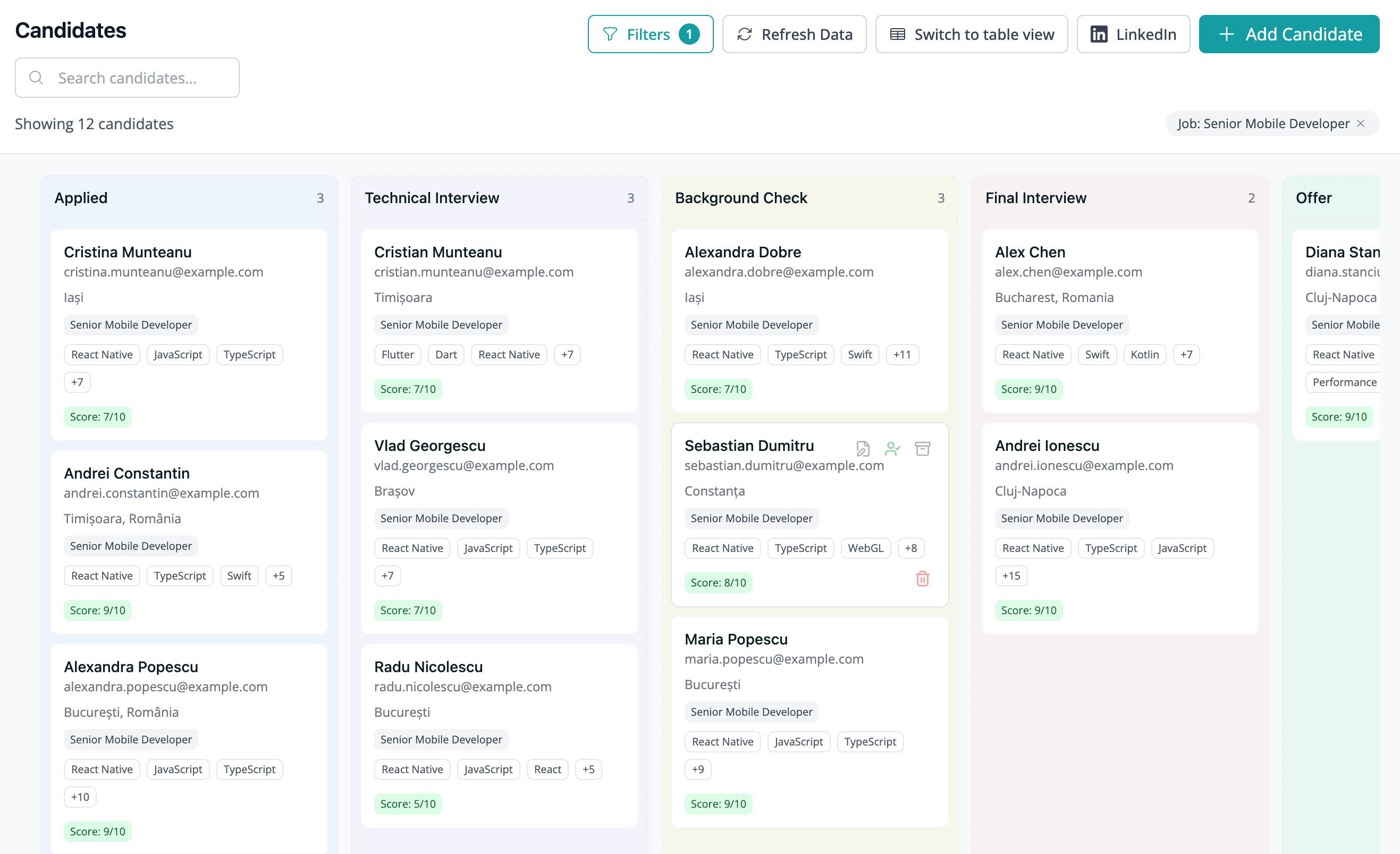
Candidates arrive through a public application form, manual entry or a LinkedIn import, into stages each company edits in settings. A candidate changes stage when a person moves the card on the board, or when someone asks an assistant to move it in a chat. Both of those start with a person. Hiring requires the hiring permission and a start date before it creates the employee record.
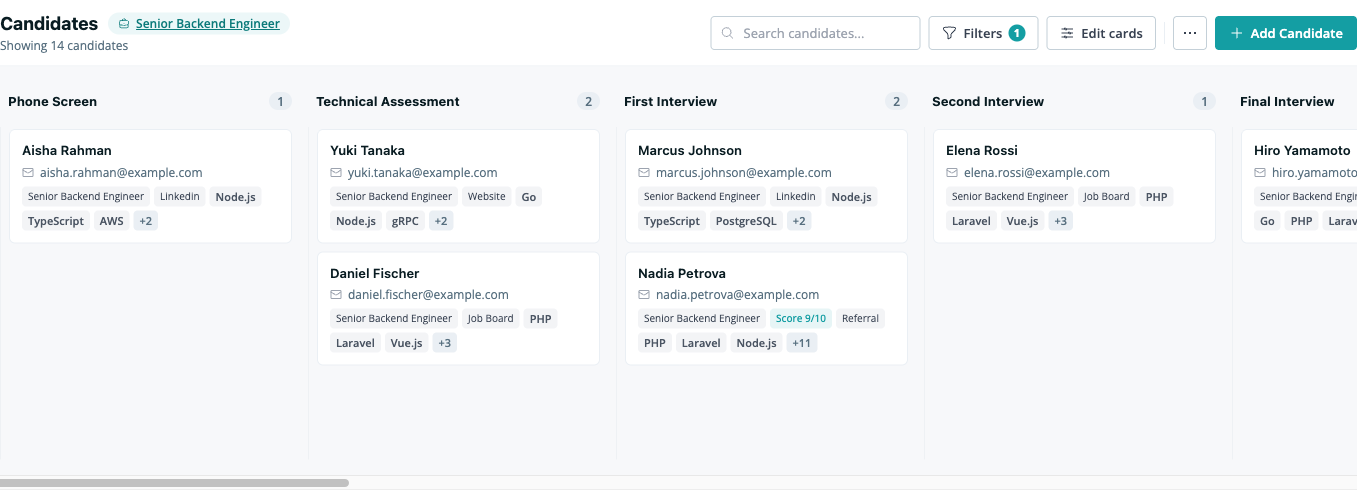
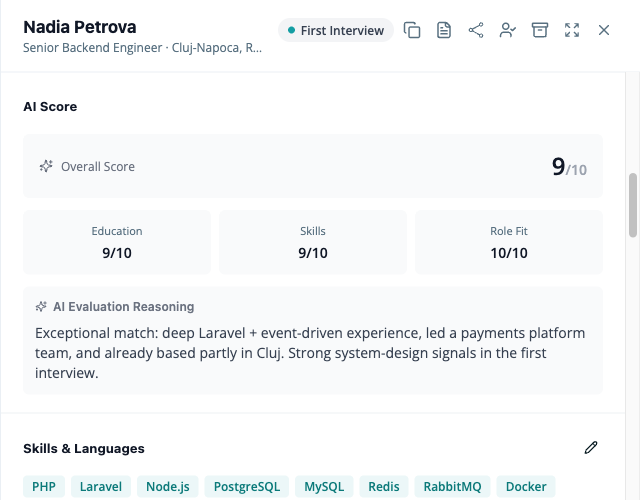
Two AI features in the hiring module touch candidates, and neither runs on its own: a recruiter clicks a button, or an assistant acts on someone’s instruction. “Fill form from CV” reads an uploaded CV and pre-fills the add-candidate form, and when you point it at a job it fills in fit scores too; nothing is saved until a human submits the form. “Generate AI score” rates one candidate against one job from 0 to 10 with written reasoning, then writes those numbers onto the candidate record, where a recruiter can type over them.
One thing to know before you build on that. Growee lets you configure an AI employee, an assistant with its own role and permissions, and give it a trigger that fires when a candidate’s stage changes. Its write-back tool reaches the notes field and nothing else, but grant that assistant the hiring permission and it also reaches the same API a recruiter uses, so a prompt you wrote could move, score or archive someone. That is your configuration, not our default, and it is the honest answer to question one above.
What Growee does not have is a decision log. The candidate record keeps who last updated it, not a history of every move: if three people moved someone through five stages, it shows the last one. That is a gap. If your compliance position depends on reconstructing who moved whom and when, press us on it.
Common questions
Who is liable when an AI tool rejects a job applicant? On the record so far, the vendor and the employer can both be on the hook. In Mobley v. Workday the court held on 12 July 2024 that Workday can be sued directly under Title VII, the ADEA and the ADA as an agent of the employers who delegated screening to it. No employer-customer has ever been a defendant in that case, so it does not decide employer liability. The agent theory adds the vendor rather than removing the employer.
Has Workday been found liable for discrimination? No. Nothing has been decided on the merits. Every ruling so far is about which claims may proceed. As of 25 August 2026 the case is in discovery on the Third Amended Complaint and no trial date appears in the public record.
What is the agent theory in Mobley v. Workday? Title VII, the ADEA and the ADA reach an employer’s agents. The 12 July 2024 order held Workday can be an agent because employers handed it a traditional employer function, writing that employers cannot escape liability for discrimination by delegating their traditional functions, like hiring, to a third party. Two narrower theories failed: employment agency, rejected in the same order, and direct employer, dismissed on 22 June 2026.
Do you have to prove the algorithm was designed to discriminate? Not for the claims that survived. The intentional discrimination claims were dismissed without leave to amend on 12 July 2024. What proceeds is disparate impact, which turns on outcomes rather than intent.
Does Growee’s hiring module screen or reject candidates automatically? No. Nothing Growee ships moves a candidate into a rejected stage, archives them or sends a rejection based on a score or any other signal. The two AI features run only when someone asks: parsing an uploaded CV to pre-fill the add-candidate form, which also fills in fit scores when you point it at a job, and generating a 0 to 10 fit score with written reasoning for one candidate against one job. Neither changes a candidate’s stage. Moving, archiving and hiring are human actions, though an AI employee you configure with the hiring permission can take them, acting on a prompt you wrote.
Before your next demo
Ask the vendor to reject a test candidate in front of you, then ask what the system recorded. Whatever it did not record is what you will reconstruct by hand the day someone asks who decided.