HR software for law firms that bill by the hour
Hours logged against the client and matter, personnel documents only the right roles can open, and associate reviews with the raise recorded on the evaluation. Payroll stays with your payroll provider.
Where Growee fits, and where it does not
Growee is general HR software, not legal software: no trust or IOLTA accounting, no matter management, no conflicts checking, no LEDES codes. Payroll belongs to Gusto, which builds law-firm compensation scales into it. CLE credit tracking and legal recruiting belong to Litera (as of August 2026). Growee holds the firm's own record of its people: hours against the matter, leave, documents with expiration dates and role-based visibility, and reviews.
Three things this actually replaces
Usually a time spreadsheet reconciled at month end, a shared-drive folder whose permissions nobody audits, and a review cycle that runs when a partner remembers.
Hours land on the client and the matter that generated them
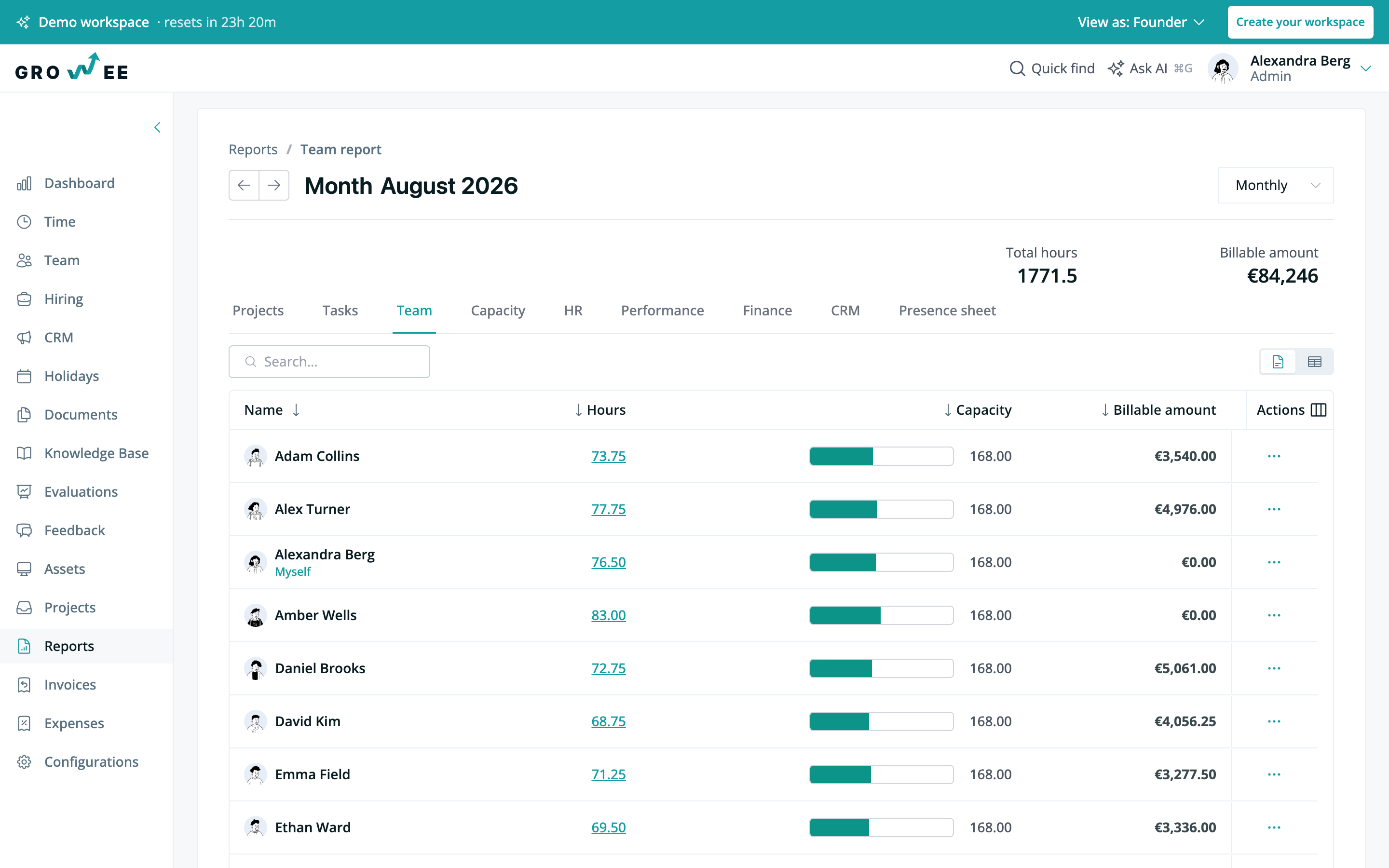
A timesheet week is one row per project, and a project points at a client, so every hour carries the matter it belongs to. Each person on a project has an hourly billable rate and a weekly allocation, and the billable amount is computed from logged time.
- One row per matter or task, hours per day, in Day and Week views
- Reports by week, month, quarter or year, and by project, task or team
- Billable hours turn into invoice line items, tracked from draft to paid (invoicing is on the paid plan)
The personnel file, with access set by role
A lawyer's file is mostly documents not meant for general circulation: the employment contract, the salary addendum, the confidentiality undertaking, a dated practising certificate. Each is a document type you define, filed on the person with an expiration date. By default, the Admin, HR and Manager roles have access to all company documents, and employees and collaborators see their own.
- Document types you define, with tags, filters and a Signed column
- Expiration alerts by email, before a credential lapses
- E-signature by link, no account for the signer, and the signed file stays on the record with a fingerprint tied to its contents
CLE certificates are stored as documents; Growee does not compute credit hours per jurisdiction. E-signature is on the paid plan; documents and expiration alerts are not. See document management →
Associate reviews happen on a date, not when someone remembers
Growee schedules evaluations in advance, sends reminders, and records the salary change or role change on the evaluation itself, which is then reflected in the employee's timeline. Admin and Manager roles see every evaluation; everyone else sees their own.
- Evaluation types you define: technical, salary, end of probation
- Scheduled dates with reminders, so the cycle does not depend on a calendar invite
- Position Change and Salary Change on the record, filterable by employee, type, date or assignee
Growee vs Gusto vs Litera
These three are not really competitors; they are three different jobs sold to the same firm. Gusto is payroll and benefits with law-firm compensation scales built in. Litera's talent suite is legal recruiting and CLE tracking for large firms. Growee is the people record around both (as of August 2026).
Gusto cells reflect gusto.com/product/solutions/industry/law-firms and gusto.com/pricing; Litera cells reflect litera.com/solutions/law-firm-talent-and-hr, all read 19 August 2026. Gusto's Simple plan is listed at $49/mo + $6 per person per month, Plus at $80/mo + $12, Premium at $180/mo + $22, billed month to month with no annual tier shown; performance and compensation management and certified HR expert access sit in Premium, or as an HR Resources add-on at $50/mo + $5 per person per month on Simple and Plus. Litera publishes no pricing: litera.com/pricing returns a 404 and the talent page routes to a demo request. "Not stated" means those pages say nothing either way. Growee figures are our published plans.
Explore the pieces
Time tracking
Hours per matter, approved.
See time trackingDocument management
Expiration dates and alerts.
See document managementE-signature
Sign by link in the browser.
See e-signatureEvaluations
Reviews with the salary change recorded.
See evaluationsLeave management
Requests, balances, planner.
See leave managementSecurity
Visibility by role, encryption in transit and at rest.
See securityHR software for law firms: common questions
What is the best HR software for law firms?
If the pain is payroll and benefits, buy Gusto: it describes itself as the small business platform built for law firms, and its FAQ says lockstep and Cravath scale salaries are easy to manage (as of August 2026). If it is legal recruiting and CLE compliance at a large firm, that is Litera's talent suite: LawCruit for applicant tracking and CE Manager for CLE. Growee covers the third case, the firm's own record of its people, at €2 per person per month.
Is Growee a legal practice-management or billing system?
No. Growee does not hold client funds, keep a trust or IOLTA ledger, check conflicts, manage matters as legal objects, or produce LEDES billing codes. It covers the part many small firms run on a spreadsheet: a project per matter with a client attached, an hourly billable rate per person, hours logged against that matter, and an invoice built from the same hours. If you need practice management, buy one and keep Growee for the people side.
How much does HR software for law firms cost?
Gusto publishes its figures: Simple at $49/mo plus $6 per person per month (as of August 2026). Litera publishes nothing; litera.com/pricing returns a 404, so budget for a sales conversation. Growee is free for up to 3 people, then €2 per person per month, or €20 per person per year, which covers timesheets, leave, documents, projects, invoicing and reviews.
One record per fee earner
Hours, leave, documents and reviews on one record, with visibility that follows the role. Free for up to 3 people.
No credit card required · Free for up to 3 people · Keep your payroll provider



 Hana Králová